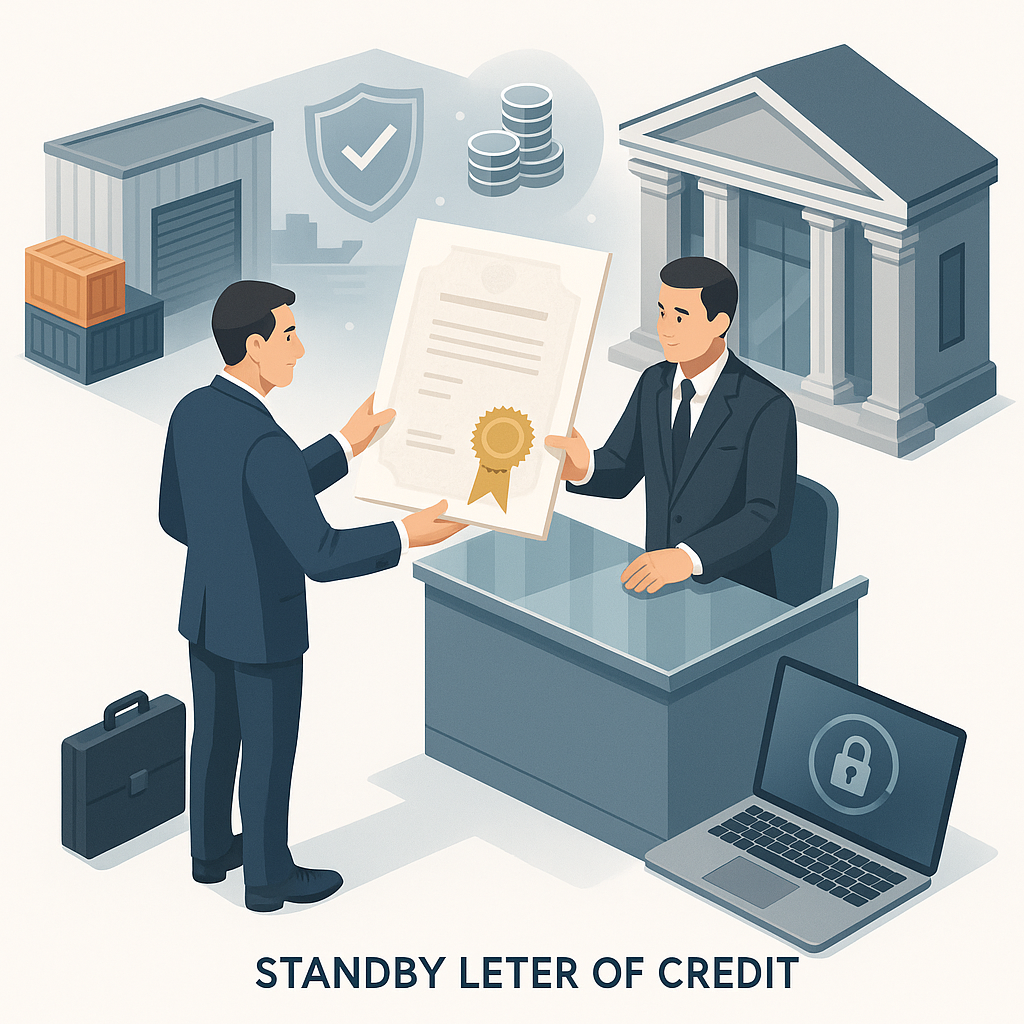
Standby Letters Of Credit in Fifth Third Bank
Standby Letters of Credit — Fifth Third Bank
A Standby Letter of Credit (SBLC) from Fifth Third Bank is a financial instrument designed to provide assurance to beneficiaries that payment will be made if the applicant fails to fulfill contractual obligations. Unlike documentary letters of credit, which primarily facilitate trade, a standby letter of credit functions as a secondary payment mechanism — a contingent guarantee that activates upon presentation of specified documents demonstrating default or non-performance. Fifth Third Bank’s SBLC product is intended to support a wide range of commercial, construction, and international transactions by reducing counterparty risk and enhancing the credit profile of the issuing client.
Key Features
- Contingent Guarantee: Payment obligation is triggered only upon proper presentation of documents that meet the terms of the standby.
- Flexible Uses: Commonly employed for performance guarantees, bid bonds, payment guarantees, lease obligations, and international trade support.
- Customizable Terms: Tenor, amount, documents required for presentation, and applicable rules can be tailored to the needs of the applicant and beneficiary.
- Available in Multiple Currencies: Issuance can be arranged in a range of currencies for cross-border transactions, subject to bank policies and regulatory requirements.
- Advising and Confirmation Options: Advising banks or confirmation by an additional bank can be arranged to provide added security to beneficiaries in different jurisdictions.
Common Use Cases
- Construction and Infrastructure: Performance and payment assurances to project owners and contractors.
- International Trade: Backing for supplier and buyer obligations where payment or performance risk exists across borders.
- Government and Regulatory Requirements: Guarantees for bids, contracts, or statutory obligations.
- Commercial Transactions: Support for lease agreements, service contracts, and vendor relationships.
- Credit Enhancement: Improves applicant’s commercial standing and facilitates favorable contract terms or financing.
How It Works
The process typically begins with an applicant submitting a request to Fifth Third Bank that outlines the terms required by the beneficiary. The bank evaluates the applicant’s creditworthiness, the underlying transaction, and any proposed collateral or security arrangements. Once approved, the bank issues the standby letter of credit in writing, specifying the conditions under which payment can be demanded, the expiry date, and the documents that must accompany a draw request.
If a beneficiary believes the applicant has defaulted, they present the required documents to the issuing bank (or the advising/confirming bank, if applicable). Upon verification that the presentation complies with the SBLC terms, the bank honors the demand by making payment up to the stated amount. The bank then seeks reimbursement from the applicant or enforces the agreed-upon collateral arrangements.
Documentation and Requirements
Typical documentation to obtain a standby letter of credit includes a completed application, corporate resolutions or authority documentation, financial statements, details of the underlying contract or obligation, and any required identification or anti-money-laundering information. Depending on the transaction and the applicant’s credit profile, Fifth Third Bank may require collateral, liens, or other security arrangements. The precise documentation and conditions are determined during the underwriting process.
Fees, Charges, and Collateral
Fees associated with standby letters of credit may include issuance or commitment fees, advising and confirmation fees, amendment fees, fees for drawing on the SBLC, and administrative charges. Fees are typically structured as a percentage of the SBLC amount, charged either upfront, annually, or upon issuance depending on the arrangement. Collateral may be required to support the bank’s credit exposure; acceptable forms of collateral depend on bank policy and the specific transaction.
Legal and Regulatory Considerations
Standby letters of credit are governed by the terms set forth in the instrument and by applicable international or domestic rules and practices. Depending on the nature of the credit and the parties’ preferences, these may include internationally recognized frameworks. Compliance with anti-money-laundering (AML), know-your-customer (KYC), and sanctions regulations is mandatory; Fifth Third Bank conducts appropriate due diligence in accordance with regulatory requirements before issuing an SBLC.
Risk Management
From the applicant’s perspective, an SBLC creates a contingent liability on the balance sheet and can affect borrowing capacity. Applicants should carefully consider the exposure created by issuance and any collateral pledged. Beneficiaries should ensure the standby’s terms clearly reflect the conditions for payment and that documentary requirements are practical and attainable. Because SBLCs are legal instruments, clear drafting and mutual understanding of obligations reduce disputes and facilitate prompt resolution when a presentation is made.
Claims, Expiry, and Amendments
An SBLC remains valid until its expiry date or until it is formally cancelled or fully drawn. Amendments to amount, expiry, or other material terms can be made with the consent of the issuing bank and, where applicable, the beneficiary. Claims must conform precisely to the documentary conditions set out in the standby; non-conforming presentations can be subject to rejection or require cure. It is essential for both applicants and beneficiaries to track expiry dates and manage renewals or replacements proactively.
Why Choose a Standby Letter of Credit?
- Enhanced Credibility: Provides beneficiaries with a bank-backed assurance of performance or payment.
- Transaction Facilitation: Enables deals that might otherwise be constrained by perceived credit risk.
- Customizable and Secure: Terms and documentation can be tailored while relying on the enforceability of a bank guarantee.
- Useful Credit Tool: Acts as an alternative to cash deposits or other forms of security.
Getting Started
Businesses considering a standby letter of credit should prepare relevant corporate and financial documents, clarify the exact terms required by the beneficiary, and engage early with their relationship manager to discuss structure, fees, and collateral requirements. Clear communication among all parties about documentary conditions and timelines helps ensure the SBLC performs as intended when called upon.
Fifth Third Bank’s standby letter of credit solution is structured to meet the needs of businesses and counterparties engaged in domestic and international commerce. By combining credit expertise, global payments knowledge, and transaction-focused service, the product aims to provide reliable contingent support that helps counterparties transact with confidence.
Address Bank: Fifth Third Center, Cincinnati, Ohio, U.S.
Bank: Fifth Third Bank
Headquarters: Cincinnati
Products: International & Trade
Type: Standby Letters of Credit








Viewed Items
Banks2go — A Comprehensive Marketplace for Financial and Insurance Services
Banks2go is a user-friendly marketplace that helps you discover, compare, and apply for banking and insurance products in one place. Whether you’re building credit, opening a business account, or shopping for auto insurance, Banks2go brings together transparent information, smart tools, and trusted partners to make selection simple and fast.
Banking Products
Credit Cards- Compare a wide range of cards across APRs, intro 0% APR periods, rewards structures (cash back, travel miles, transferable points), welcome bonuses, balance transfer terms, foreign transaction fees, and penalty rates.
- Filter by your goals—everyday cash back, premium travel, no-annual-fee, balance transfer, or credit building—and see estimated value based on your spending profile.
- Get instant prequalification checks with no impact to your credit score, complete secure online applications in minutes, and track application status in real time.
- See key terms clearly explained: grace periods, minimum payments, credit limits, authorized user rules, and redemption options (statement credit, travel portals, partner transfers).
- Access educational guidance on responsible credit use, utilization ratios, and how on-time payments can strengthen your credit over time.
- Compare business accounts side-by-side on monthly maintenance fees, minimum balance requirements, included free transactions, ACH and wire pricing, cash deposit limits, ATM access, and treasury features.
- Explore value-added services like merchant processing, virtual cards, integrated invoicing, and expense management.
- Onboard quickly online for LLCs, corporations, and sole proprietors with clear documentation checklists and guided KYC/AML steps.
- Connect your account to popular accounting and finance tools (e.g., QuickBooks, Xero) for streamlined reconciliation, payroll, and tax prep.
- View specialized options for startups, freelancers, and nonprofits, including accounts with no or low fees and scalable limits as your business grows.
- Find student-friendly cards with no or low annual fees, simple rewards, spending controls, and features designed to build credit responsibly.
- Get clear eligibility guidance for both domestic and international students, including SSN/ITIN requirements and income verification tips.
- Learn about security deposits for secured cards, credit limit increases with good behavior, and tools that help track spending and avoid late fees.
- Access resources on establishing credit from scratch, protecting your score, and using student benefits like streaming or transit rewards.
Insurance
Auto Insurance- Compare quotes from top-rated national and regional carriers across states, with coverage options that include liability, collision, comprehensive, uninsured/underinsured motorist, roadside assistance, and rental reimbursement.
- Customize deductibles and limits and see how changes affect your monthly premium in real time.
- Explore common discounts—safe driver, multi-policy, good student, usage-based/telematics, multi-vehicle—and understand eligibility criteria.
- Bind e-policies in minutes with digital ID cards and flexible payment options (monthly, quarterly, semi-annual).
- Access plain-English explanations of state minimums, gap insurance for financed vehicles, and when it makes sense to add or drop coverage types.
Easy Selection
Smart Filtering and Personalization- Use dynamic filters and guided questionnaires to surface recommendations based on your financial profile, risk tolerance, and specific goals (e.g., pay down debt, earn travel rewards, reduce fees).
- Compare key terms side-by-side—rates, fees, limits, perks, coverage details, and exclusions—so trade-offs are obvious and transparent.
- Read concise summaries and detailed breakdowns in plain English, with highlight callouts for gotchas like deferred interest, balance transfer fees, or coverage gaps.
Wide Catalog
Broad, Up-to-Date Network- Access a wide network of U.S. banks, credit unions, fintechs, and national insurers—all in one place—so you don’t need to visit branches or spend hours on phone calls.
- See current promotions, limited-time offers, and partner deals aggregated and refreshed regularly, with clear eligibility and expiration details.
- Benefit from standardized comparisons that make complex products easy to understand and evaluate.
Why Banks2go
- Speed and Transparency: From prequalification to application and policy binding, steps are consolidated and clearly explained.
- Education Built In: Bite-sized guides and checklists help you make confident decisions without financial jargon.
- Secure and Privacy-Conscious: Application flows follow industry-standard security protocols, and prequalification tools avoid hard credit pulls unless you opt to apply.
Choose what you need
 More than
50000
services
 Convenient search
 The most beautiful site
 The site works 24/7